Sober October: The Month Everything Changed

It was the beginning of September 2025 when my husband returned from a failed hunting safari with three clients. The week leading up to it had been stressful — we could hardly communicate due to how remote the area was, and during the few moments I did reach him, I felt the pit creep into my stomach. Things were going wrong. Fast.

The hunt collapsed halfway through. I scrambled to arrange flights home, while holding our lives together on this side. When he finally arrived back late on a Sunday night — exhausted, deflated, and carrying the weight of failure — chaos rolled in behind him. A week later he left again for another hunt that would keep him away most of September.

And that’s when the world shook in a different way.

During this time the CEO of Turning Point USA, Charlie Kirk, was assassinated. My kids and I sat until the quiet hours of the South African morning watching his memorial service live. As I listened, something ignited in me. This man lived boldly for God — unashamed, unfiltered, and unwavering. He called men to rise, lead their homes, and stand under God’s authority so their wives could flourish in their God-given calling.

And in that moment, with tears burning behind my eyes, I realized something painful and true:

I had been living lukewarm.
One foot in the world, one foot in the Kingdom.
Drifting. Coping. Surviving.

I felt my life folding open before me — decades of striving, storms weathered, pockets of beauty — yet a hollow ache that whispered: You were created for more than this.

I wanted transformation. I wanted Kingdom alignment. I wanted to stop wasting time wandering far from the Father who had always been waiting.

But I wasn’t walking this life alone. My husband was stuck in the same lukewarm space. And so the question rose: How do I create an opening for God to lead us out of this wilderness?

The answer came sharper than expected: Sober October.


The Plan

I had been experimenting with alcohol-free stretches for the last few years. By then I had gone nearly two full months with only two or three glasses of wine. I was training hard, eating clean, and feeling the clarity and strength that comes when the body and spirit finally breathe again.

So when my husband returned home, I didn’t suggest — I declared — that October would be a fast:

  • No alcohol.
  • Daily time in the Word together.
  • Aligning our home and business under God.
  • Church every Sunday and joining a cell group.
  • Stewardship and Kingdom leadership at the center.

He hesitated — mostly at the alcohol part — but finally agreed.

What followed wasn’t holy and peaceful at first. It was messy.

I was angry. Angry at him for decisions made. Angry at myself for choices tolerated. Angry at both our parents for not modeling spiritual leadership better. Angry that it took me nearly fifty years to face the truth.

And all of this while facing financial loss, legal threats from clients over the failed hunt, and an income winter ahead.

We were tired. Wounded. Scared. But we were deciding to stand.


Day One

Wednesday, 1 October 2025.
Alarm at 4:45am. Coffee. Dining room table.
Two stubborn hearts learning to bow again.

Those first mornings were raw — both of us bruised, licking wounds, trying to shift blame, then learning slowly to drop it. But by week two, something softened. We began repenting — truly repenting — for years of self-reliance, pride, and financial bondage.

We gave God our business, our marriage, our direction, and our future. We confessed that trusting our own wisdom had led us into loss and strain — and we asked Him to lead instead.

By week three, my husband was changing — deeply and visibly. For the first time in 29 years his body and spirit were sober. Clear. Awake. The spiritual ground under our home was shifting.

We still didn’t have answers for the financial mess. We still felt the weight. But now we were walking aligned, submitted, and together — finally stepping into our God-designed roles as husband and wife.


Today

It’s the 3rd of November 2025 as I write this. We still don’t know exactly how everything will unfold, but I know this:

God knows.
And He is leading.

My husband is stepping into spiritual headship with humility and conviction. Our mornings with God continue. Our business decisions now go through His hands first, not ours.

We have traded survival for surrender, and confusion for calling.

Sober October wasn’t just about alcohol.
It was about obedience.
About repentance.
About turning our feet toward the Kingdom and not looking back.

And for the first time in a long time, I feel peace.

Unfiltered. Unfinished. Redeemed.
Grace in the Blended Spaces

Being a stepmom is probably one of the hardest things I have ever done. People look at us as a family and often say we make it look so easy. Those who don’t know us well usually assume that all three children are mine — and are surprised to learn that two out of the three are my stepchildren.

My biggest fear is that women contemplating divorce might look at me and think that starting over isn’t so hard. But it is. Very hard.

Ask any parent — raising children is no easy task. Raising children who aren’t biologically yours brings unique challenges, filled with complexities that require patience, prayer, and perseverance.


The DNA Divide

When my biological child acts out in a certain way, I can almost always recognize myself or his father in his behaviour. That makes it easier to respond with understanding. With a stepchild, however, you only know one half of their DNA intimately. The other half is a mystery. A person known from afar and through comments and conversations with the children.

And that mystery extends beyond genetics — it shapes the way they see the world, how they process emotions, and what triggers them. Learning to love and parent into that unknown space takes humility and grace that only God can supply.


The Parenting Puzzle

Different parenting styles are another ongoing challenge. Establishing rules and consistency at home becomes complicated when the other household operates differently. Sometimes it’s even the small things — what foods are sent along, or what products are introduced — that create disruption. Especially during the younger years, when parents control to a larger extent what children are exposed to. It takes years to discern which battles are worth fighting and which are best surrendered to peace.

In our case, all the children live with us permanently. This means that by default, I am the parent who enforces structure, discipline, and boundaries. Their biological mother, who only sees them during short school holidays, naturally becomes the “fun mom.” When the children are with her, it’s a holiday. When they return, it’s back to real life — homework, chores, rules.

It used to frustrate me deeply. I tried to involve her more with the harder side of parenting, especially as my stepdaughter entered her teenage years. But I quickly learned that words and promises made over a phone call often don’t hold up in reality.


A Promise Before God

Eight years later, I have been raising my stepchildren for three years longer than they lived with their biological mother. Yet she remains their mom — and always will. There were moments when I was ready to give up, but I made a promise to my husband before God — a covenant — that I am determined not to break.

We live in a time when marriage is often treated as a contract rather than a covenant. The sacredness of marriage as designed by God has faded into the background. The world tells women to “choose happiness,” to leave if things get hard. “The children will be fine,” they say.

But those words are far from the truth. When you live in a blended family, you see clearly just how deeply the fracture of divorce runs — and how far it takes us from God’s original design.


A Call to Restore

I’m not saying that it’s impossible to find joy in a second chance. I love my husband. We do life together as a team. But hear me clearly — if there is a way to restore your marriage, fight for it. Seek God first. Pray without ceasing. Do not give up simply because it’s hard.

Unless your life or your children’s lives are in danger, do everything in your power to bring your marriage back under God’s covering. Many marriages fall apart not because of tragedy, but because couples have drifted away from the Word — from God’s plan for unity, love, and stewardship of family. Instead they shifted their focus to the world’s view on marriages. Easy to step into and easy to jump out.

“But at the beginning of creation God ‘made them male and female.’
For this reason a man will leave his father and mother and be united to his wife,
and the two will become one flesh.
So they are no longer two, but one flesh.
Therefore what God has joined together, let no one separate.”

Mark 10:6–9

Marriage is hard work. It refines you. It teaches humility, forgiveness, and compromise. But when you put God at the centre — truly at the centre — it becomes a space of grace rather than struggle.

When you put an ex-spouse at the centre, chaos reigns.
Choose wisely.

Unfiltered: Smoke Signals

Sharing personal stories with the hope of helping someone else is essentially the purpose of this blog. As well as figuring out this thing called life for myself.

I’ve been going through a rough patch the last few days. It felt like too many personal and work issues collided all at once — pressing on every nerve and fraying every edge.

Physically, I was wiped out by an exceptionally heavy period. The kind that leaves you drained and disoriented. I couldn’t train for the better part of three days. And after almost four weeks of focused, intentional weight training, that felt like failure. Not even a long walk. The movement my body had come to rely on was suddenly unavailable, and it hit me harder than I expected. Blue days followed.

Missing Out

There was a fundraiser at my daughter’s school — a Warrior Race kind of day. Normally I would’ve jumped at the chance to join a team and run, climb, laugh. But not this time. Not with the fatigue and discomfort. We went, stayed for a couple of hours, and left before the fun really began. Another notch up on my scale of frustration.

Back at work, small fires caused by other people’s slackness meant I had to step in and sort things out. Again. The irritation crept in like smoke under a door. I felt used. Taken for granted.

Then Came the Cigarette

But the thing that finally pushed me over the edge was a small, almost cinematic moment. My husband’s new habit of smoking a cigarette before bed.

It started a couple of weeks ago when he casually announced he was going outside for a smoke. I was surprised — this from a man who didn’t even smoke in his twenties. At first, I brushed it off. But now it’s become a thing. He goes out when I’m in the bath, then comes back in, cold and smelling like smoke, being all warm and enamoured with me.

I didn’t want to be harsh or dismissive, but kissing my man after a cigarette just didn’t sit well with me. And worse — it felt like while I was focused on getting strong and healthy, he was sliding in the opposite direction. We were out of sync. I lost it. I asked him what on earth he was thinking starting this now, at his age. His answer was soft: it helps him relax and unwind under the stars.

We talked it through. We resolved it, mostly. But it stirred something deep in me.

“When you share a life with someone, their choices aren’t just theirs anymore.”

When It’s Your Person

If this were a friend, I’d be curious. Maybe concerned. But I wouldn’t be shaken. But this — this is the man I’ve chosen to walk through life with. So no, I can’t just let it go. It’s not about judging. It’s about sharing a life. Sharing teenagers who are watching. A business that depends on both of us being healthy and strong. A future we’ve built brick by brick.

So many questions:
What example are we setting?
Why now?
What is he carrying that I don’t see?

Living with Love and Limits

Today I’m calmer. And I’m sitting with the question: Why did this shake me so deeply?

Maybe it’s the unspoken agreement in marriage — that we will do our best, for the sake of each other and the shared life we’re building. When one of us breaks that rhythm, even in a small way, it feels like a breach. Like something sacred was missed or misunderstood.

Loving someone means wanting the best for them, not just for their sake, but for yours too. Because we’re in it together.

And maybe the deeper question is this:
How do we love fully and unconditionally, while still drawing boundaries that protect us both?

It’s made me think of the families dealing with deeper struggles — addiction, depression, disconnection. This wasn’t that. But the feeling, I imagine, carries a similar weight.

How do we stay soft in the face of disappointment?
How do we hold space without losing ourselves?
How do we speak the truth, without shattering the love?

I don’t have the answers.
But I’m asking the questions.

And for now, that feels like a good place to begin.

The Backpack

I watched a film over the weekend—one of those tender stories about love, loss, losing and finding yourself again.

There was a particular scene that lingered.
The lead character reconnects with a woman he once loved in high school. They reminisce. He asks if she ever made it to Paris, the city of her dreams.

She smiles, a little sad.
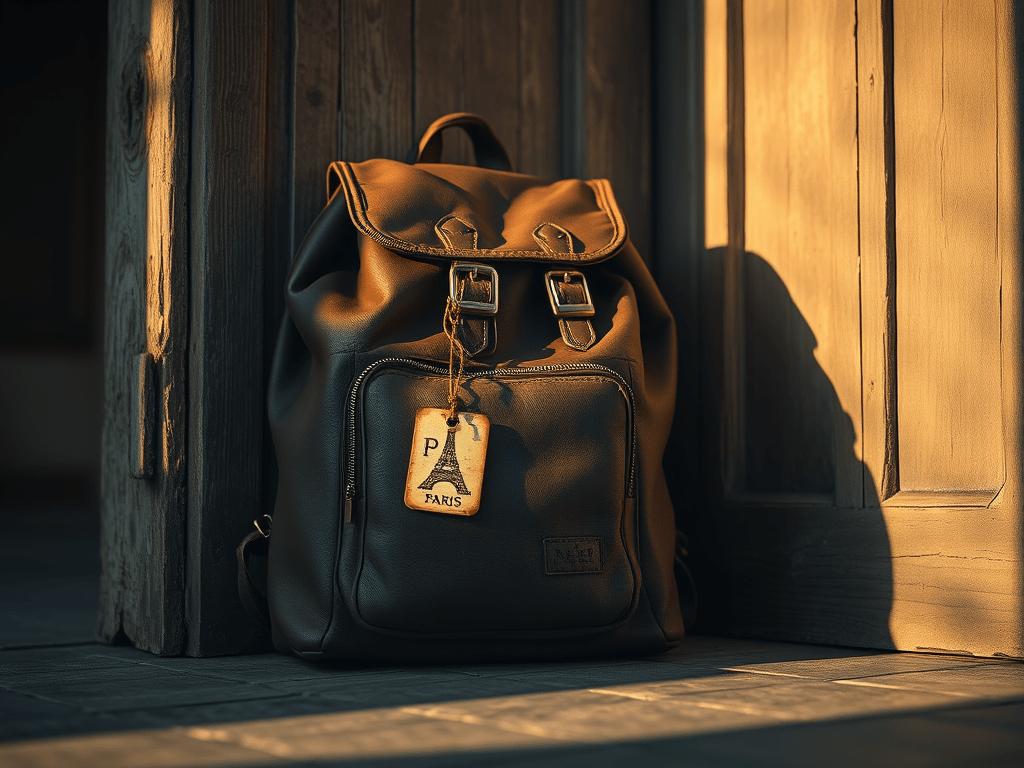
Tells him she bought a backpack—specifically chosen, with little pockets for everything she’d take on her journey. She placed it by her front door, ready to go. But life kept happening. A sick family member. A work emergency. The wrong season.
So the bag sat. Unused. Unmoved.
Eventually, she grew tired of seeing it—tired of being reminded of the thing she never did. So she packed it away at the back of a closet.

It’s still there.
She never saw Paris.


The Dreams We Bury

That moment sat with me.
How many of us have a proverbial backpack waiting by the door?
How often do we tuck our dreams into the back of a closet—not because we can’t chase them, but because the excuses are more comfortable than the unknown?

We say:
“I don’t have the time.”
“I have responsibilities.”
“I’m too old now.”
“I’m scared.”
“I missed my chance.”

And then… decades slip by.
The yearning is still there. But it’s twisted now—threaded with regret, steeped in what-ifs.


But What If It’s Not Too Late?

What if it was never about missed chances?
What if it’s just been about timing?

What if we stopped staring at the closed door of the past, and simply opened a new one?
What if the question became:
Why not now?


Filling Up So I Can Pour Out

What I’ve come to learn is this:
The more I move toward my dreams, the more I can give to others—not in money or material things, but in what truly matters.

Love.
Presence.
Wisdom.
Laughter.
Patience.
Grace.

When I fill my own cup, I have something meaningful to pour.


A Letter to My Younger Self

If I could go back, I’d whisper:

Live, my girl. Really live.
Follow the wild call of your own path.
Stumble, rise, dance barefoot in the small joys.
Don’t be afraid to fail. That’s how the soul finds her rhythm.


The Way Home

The longer you resist your own nature, the harder the return.
But even if you wander for years, the journey is never wasted.

Because once you find your way back—once you arrive in that sacred space where you truly belong—even the hard days feel like home.


“Don’t pack your dreams away. Dust them off. Wear them in.”
Wild Soul Notes

Raising Teens While Riding Hormonal Tides— or — What Was God Thinking?!

“What was God thinking when He decided I should be raising teenagers whilst going through perimenopause? It is the ultimate clash of hormones!”

A random internet post, or divine comedy? Either way, it hit home.

I read something funny the other day. It was a woman asking, “What was God thinking when He decided I should be raising teenagers whilst going through perimenopause? It is the ultimate clash of hormones!”

I was pondering this, as it’s very much a reality in my life. I’m pushing fifty and have three teenagers in the house. One biological son of 15, a stepson aged 14 and stepdaughter of 13. I find that mostly I just don’t seem to have the patience I had when I was in my twenties and even thirties.

Did I Miss the Timing?

Then the thought came that perhaps if I had children earlier in life, I wouldn’t be in this situation. So I started looking at history.

In biblical times, childbearing began shortly after marriage. It wasn’t uncommon for girls to have their first child between ages 13 and 16. But many continued having children up to their 30s and 40s—assuming they survived childbirth and remained fertile.

In the 1800s to early 1900s, women typically had babies in their early twenties. But that began to shift. By the late 1900s and into the 2000s, childbearing age steadily rose. Today, many women only begin having children at 28 or older. This shift is due to education, careers, contraception, autonomy, delayed marriage, and fertility technology.

Maybe There Was a Plan

Looking at this, I began to wonder: perhaps our Creator never intended for us to go through major hormonal transitions while our children were in the thick of their own. As with everything in creation, maybe there was a plan for it all to flow in harmony.

I had my biological child at 33. And while I wouldn’t trade that for anything, the truth is: teenagers are navigating a wild space between childhood and adulthood, and they need us to be patient, steady, wise. But it’s hard to show up that way when your nurturing hormone—oestrogen—is waving goodbye at a rapid pace.

If we go back to basics—without moral overlays—humans become physically capable of reproduction around 13. Which means, in the past, people would’ve been raising teenagers when they were still in their physical prime. Absurd in a modern context, yes, but biologically and emotionally? It kind of makes sense.

Did We Get Too Clever for Our Own Good?

Did we become so clever, so advanced, that we messed up nature’s rhythm?

Life has an invisible beat. And humans, for some reason, keep missing it—then land up playing a completely different tune, and we wonder why we feel confused, out of sync, and frustrated.

Life has an invisible rhythm. And humans, for some reason, keep missing a beat.

But Here I Am

Look, what’s done is done—and I’m not getting out of this raising-teens-while-riding-hormones situation. Honestly, I’m also glad I didn’t have a child at thirteen. That would’ve been its own kind of chaos.

Yet, I’m sensing more and more that the only way forward is to remember. To tune back into the ancient rhythm, the one still humming beneath the noise. To let go of my mind for a moment. And allow my life to flow again.

This way, we may just all make it through this crazy ride, mostly intact.

PS. Condolences to hubby, standing on the side, watching the proverbial shit show, with no idea what’s going down!

The Forgotten Form

and the unexpected return of an old feeling


I’ve always thought of myself as calm in a crisis.
Collected. Quick to pivot. Someone who makes a plan.
But earlier this week, something small and strange undid me —
and it’s still lingering in my chest like a whisper that wants to be heard.


A slow unraveling

My son was heading off on a cricket tour, and we had a 50-minute drive to the next town from our farm to meet the bus. All the usual prep had been done — bags packed, snacks ready, indemnity form completed and emailed to the teacher a week prior. I even had the original form printed and placed carefully on my desk.

And still, that morning, I forgot it.

We were sitting at the fuel station, waiting in the car, when my son casually mentioned that the teacher had just reminded all the parents to bring the original form. My stomach dropped. I went cold. I looked at the time: five minutes until the bus arrived.

Panic rose like wildfire.

I ran into the little shop and asked for the manager. A young woman strolled out slowly. I explained the situation — could she possibly help me print something if I emailed it to her? Her disinterested expression only added to the rising dread. But eventually, she helped. The bus was late. I printed the form. Signed it. Delivered it just in time.

“Oh, I brought extra copies,” the teacher chuckled.
“I figured some parents might forget.”


What lies beneath

The next morning, I couldn’t stop thinking about my reaction.
Why had I spiraled so hard? It wasn’t public. No one but the petrol station manager knew how panicked I was. But still, it shook me.

So I sat with it.

And what came to me was this:
sometimes it isn’t the current moment that we’re reacting to.
It’s a memory — something lodged deep in the nervous system —
rising up through the cracks.

Somewhere in my past, I must have felt the same kind of fear.
The kind that says: You’ve failed. You’ve forgotten something important. You’re not enough.
Maybe it was from childhood. Maybe early adulthood.
I haven’t quite found it yet.

But I’m looking.


Unpacking the trigger

This is the work now — not just the external rebuilding of strength and purpose, but the inner sorting too. Learning what triggers me. Tracing it back. Giving it space. Then letting it go.

“Until you make the unconscious conscious, it will direct your life and you will call it fate.” — Carl Jung

Because I don’t want to be governed by old ghosts.
I don’t want my nervous system to keep dragging me back into stories I’ve already outgrown.

Fear and anxiety are sneaky companions. We bury them.
And then one day, you forget a form…
and they rise like a flame to remind you: you still haven’t faced this.

But when we do —
when we name it, sit with it, and finally choose to release it —
we reclaim power.


Coming home

And slowly, breath by breath,
we come home to ourselves.